
home
webdesign
webhosting
api
sms
email
facebook
maps
m2m
mobi
rss
barcodes
sfx
contact
This concept of storing data in a format that includes self-describing data, or metadata, is seen as the way forward for online information, ultimately leading to a more intelligent internet that can really answer your questions. This technology will be considered as Web 3.0 and is being investigated by online heavyweights Google, Facebook and Twitter.

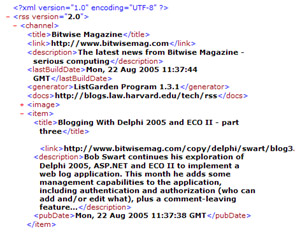
An example of XML that describes an RSS feed


really simple syndication of content
Publishers make their earnings from users viewing and interacting with their content online. The problem is that most users are interested in a variety of websites and don't have time to read through each one on a daily basis. Thus it became necessary to develop a way to deliver content from multiple sites in a uniform and summarised format so that the aggregation of new content from several sites could occur for easy occasional browsing. This technology is called an RSS feed, or just RSS for short. Users can view their favourite RSS feeds in an RSS aggregator online, via software on their PC or on their mobile phone.RSS changes the world
An RSS feed contains XML (extensible markup language) - a data format that is readable not only by people, but by machines too. Feeds contain multiple items of content and each item has a set of standard features like a headline, main body text, thumbnail image and a web address. XML contains tags that denote each of these features so that the RSS reader knows how to display things to the user. These tags look like this <title>James and the Giant Peach</title> (see left).This concept of storing data in a format that includes self-describing data, or metadata, is seen as the way forward for online information, ultimately leading to a more intelligent internet that can really answer your questions. This technology will be considered as Web 3.0 and is being investigated by online heavyweights Google, Facebook and Twitter.
why RSS can help your business
If you produce a lot of content daily, people may want to follow that content by means of an RSS feed. I can set this up for you. If your business needs to communicate information with other websites via an API in XML I can so this too.
An example of XML that describes an RSS feed

Waverley Business Park, Mowbray, Cape Town, South Africa